
 British Pounds
 US Dollars
 EURO
EURO
 Australian Dollar
 Canadian Dollar
 Singapore Dollar
 Switzerland Franc
 Denmark Krona
 Hong Kong Dollar
 Japan Yen
 Polish Zloty



Gemini 200 Concorde G-BOAD – The Supersonic Legend Now on Display in New York
Posted by Malcolm on 6th Mar 2026
Concorde G-BOAD – The Supersonic Legend Now on Display in New York
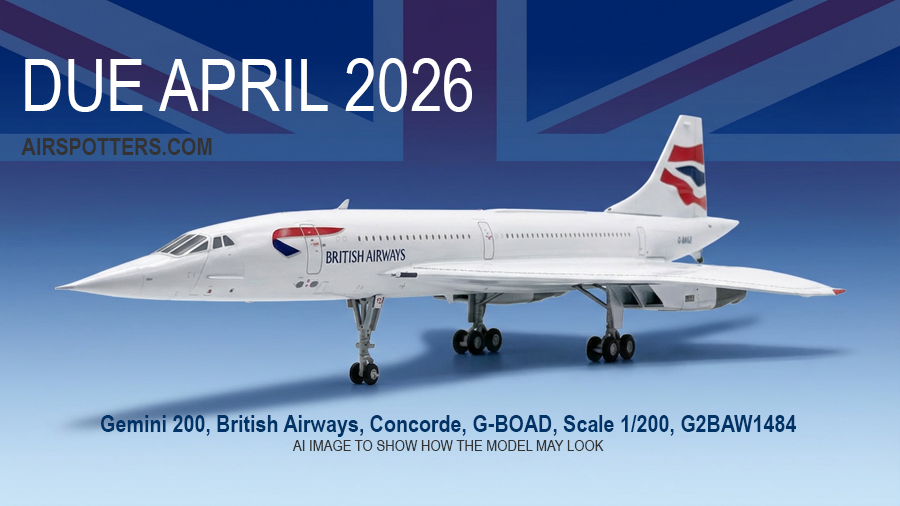
Few aircraft in aviation history have captured the imagination quite like Concorde. Sleek, impossibly fast, and unmistakably elegant, it represented the very peak of technological ambition in civil aviation. One of the most famous examples of this legendary aircraft – British Airways Concorde G-BOAD – now rests proudly on display in New York, allowing visitors to stand face-to-face with one of the most remarkable airliners ever built.
The Dream of Supersonic Travel
Concorde was the result of a remarkable collaboration between Britain and France, developed jointly by British Aerospace and Aérospatiale. When it entered service in 1976 with British Airways and Air France, it became the world’s only operational supersonic passenger transport.
The aircraft could cruise at over Mach 2 (around 1,350 mph / 2,150 km/h) and climb to altitudes of around 60,000 feet, twice the cruising height of most airliners. From that altitude, passengers could actually see the curvature of the Earth – something few commercial travellers had ever experienced.
Concorde transformed the famous London–New York route, cutting journey times roughly in half. What normally took seven hours could be completed in just over three.
Concorde G-BOAD – “Alpha Delta”
Among the British Airways fleet, G-BOAD, known to crews as “Alpha Delta”, became one of the most famous airframes.
First flown on 25 August 1976, the aircraft spent nearly three decades crossing the Atlantic in style, carrying passengers between London and New York at twice the speed of sound.
G-BOAD also made aviation history by setting a record for the fastest transatlantic passenger flight, completing the journey from New York to London in just 2 hours, 52 minutes and 59 seconds.
Like several Concordes, it even briefly wore a special British Airways / Singapore Airlines joint livery, symbolising Concorde’s global prestige.
The End of an Era
Despite its technological brilliance, Concorde faced growing challenges. Rising operational costs, environmental concerns, and declining demand following the events of September 11, 2001, eventually led to its retirement.
The final commercial Concorde flights took place in 2003, bringing to a close one of the most extraordinary chapters in aviation history.
Rather than disappearing entirely, many Concordes were preserved in museums around the world so that future generations could experience these incredible machines.
Concorde in New York
After its final flight to New York in November 2003, G-BOAD was transported by barge to its new permanent home at the Intrepid Museum on Manhattan’s Hudson River waterfront.
Today, the aircraft sits at Pier 86 beside the historic aircraft carrier USS Intrepid, where it remains the only British Airways Concorde on display in the northeastern United States.
Visitors to the museum can see the aircraft up close and even join guided tours that explore the cabin and cockpit of this supersonic icon.
In recent years, the aircraft has undergone restoration work to preserve its structure and appearance, so it can continue to inspire aviation enthusiasts for decades to come.
Concorde’s Lasting Legacy
Concorde remains a symbol of what aviation once dared to achieve. It was not just an aircraft; it was a statement that speed, elegance and engineering ambition could come together to redefine travel.
Standing beneath G-BOAD in New York today, visitors are reminded that the future once travelled faster than sound.
And for collectors, aviation historians, and enthusiasts alike, Concorde will always represent the golden age of supersonic passenger flight.