
 British Pounds
 US Dollars
 EURO
EURO
 Australian Dollar
 Singapore Dollar
 Switzerland Franc
 Denmark Krona
 Hong Kong Dollar
 Japan Yen
 Sweden Krona
 Polish Zloty
Flying the Flag: How 1974 Rewrote the Skies and Created British Airways
Posted by Malcolm on 3rd Jul 2026
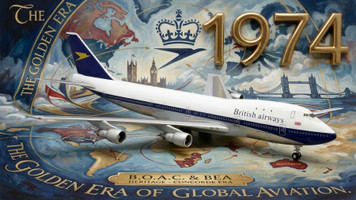
Take a close look at the stunning artwork in the image. The bold gold typography screams 1974. The backdrop features London's iconic skyline, a sweeping world map, and a majestic Boeing 747 proudly sporting the freshly minted "British Airways" title.
This image perfectly captures the dawn of a new titan in the skies. On April 1, 1974, the modern incarnation of British Airways was officially born. It wasn't just a simple corporate rebranding; it was one of the most massive and influential aviation mergers in history.
The Great Conjunction: When Giants Combined
Before 1974, British state commercial aviation was divided between two powerhouses, each ruling their own distinct slice of the sky:
-
BOAC (British Overseas Airways Corporation): The long-haul specialist. Operating the legendary "Speedbird" callsign, BOAC connected the UK to the far reaches of the globe—from New York to Tokyo and Sydney.
-
BEA (British European Airways): The short-haul champion. Armed with their iconic "Speedjack" livery, BEA was the undisputed king of European and domestic travel.
When the UK government decided to fuse these two giants—along with regional carriers Cambrian Airways and Northeast Airlines—it created a unified global airline empire. For the first time, passengers could fly from a small regional UK airport all the way to the other side of the world under a single, unified flag carrier.
A Design for a New Decade
As seen on the model aircraft in the photo, the merger brought about a brilliant era of transition. The task of creating a unified identity fell to the design agency Negus & Negus. They had to elegantly bridge the rich history of the past with a bold look for the future.
For a brief period in the mid-1970s, airport tarmacs were a fascinating mosaic. Aircraft underwent a rolling transformation, often wearing the classic BEA or BOAC tail symbols while proudly displaying the new British Airways lettering across the fuselage—a hybrid look beautifully celebrated in this artwork of the exact model.
Stepping into the "Golden Era"
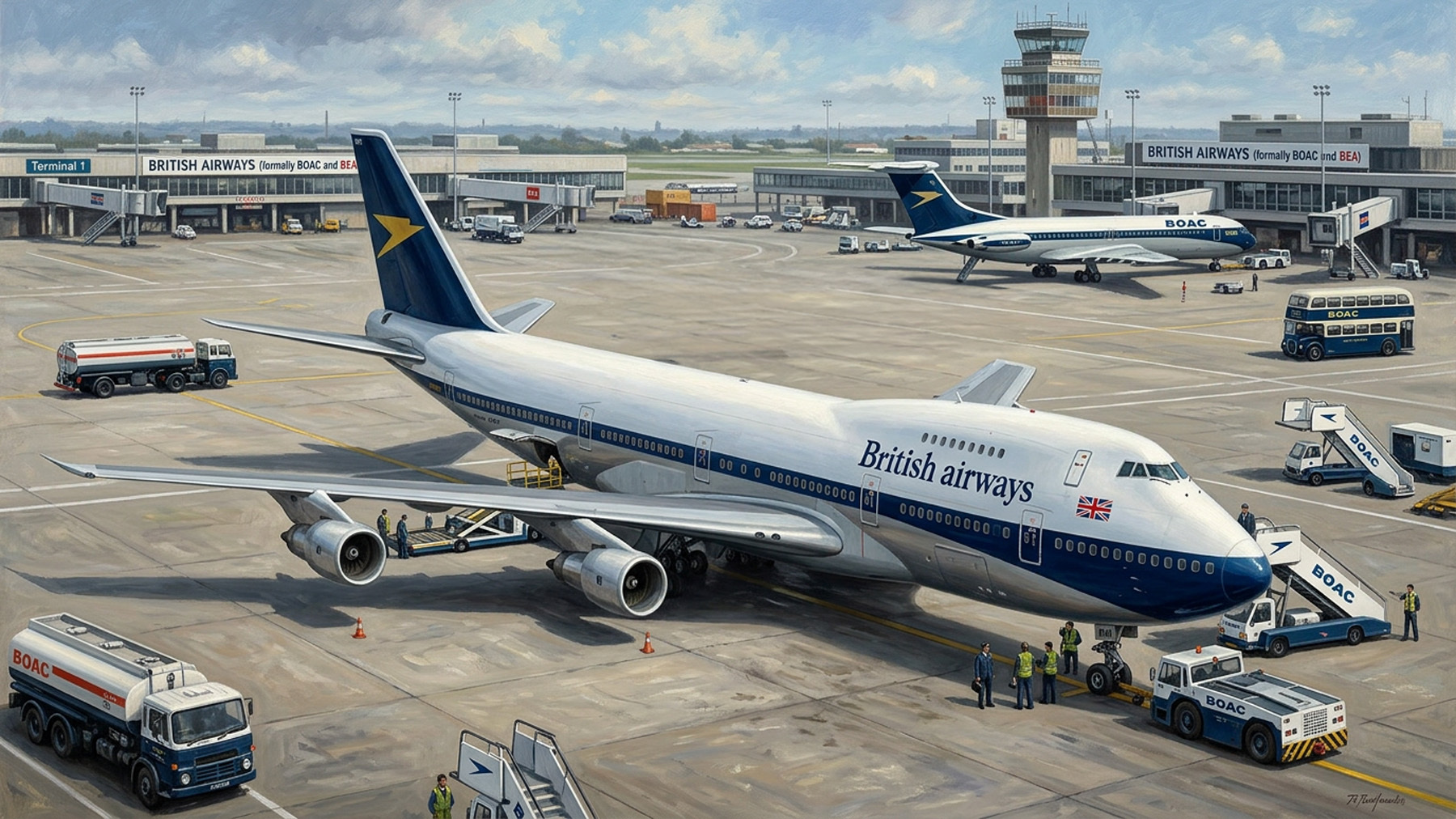
The plaque at the base of the artwork states: "B.O.A.C. & B.E.A. Heritage - Concorde Era." The mid-1970s truly marked a spectacular high-water mark for global aviation, driven by two massive milestones:
-
The Age of the Jumbo Jet: The Boeing 747 (the type modelled in the artwork) revolutionised mass international travel, vastly increasing passenger capacity and making global destinations accessible to millions.
-
The Supersonic Future: Just two years after the merger, in 1976, British Airways would make history by introducing regular passenger service on the majestic, supersonic Concorde, flying commercial passengers at twice the speed of sound.
A Legacy That Still Flies High
What started in 1974 as a complex puzzle of blending vastly different corporate cultures, massive fleets, and distinct operational styles ultimately forged one of the most recognisable brands in the sky.
What began in the era of retro travel and jumbo jets has evolved into a powerhouse connecting over 200 destinations worldwide. It all took off from that pivotal moment in 1974, when British aviation truly united to fly the flag across the globe.
The 1974 merger didn't just create a new airline—it built a global icon that defined the golden age of flight and continues to bridge the world today.